Why Do You Suddenly Stop Scrolling?
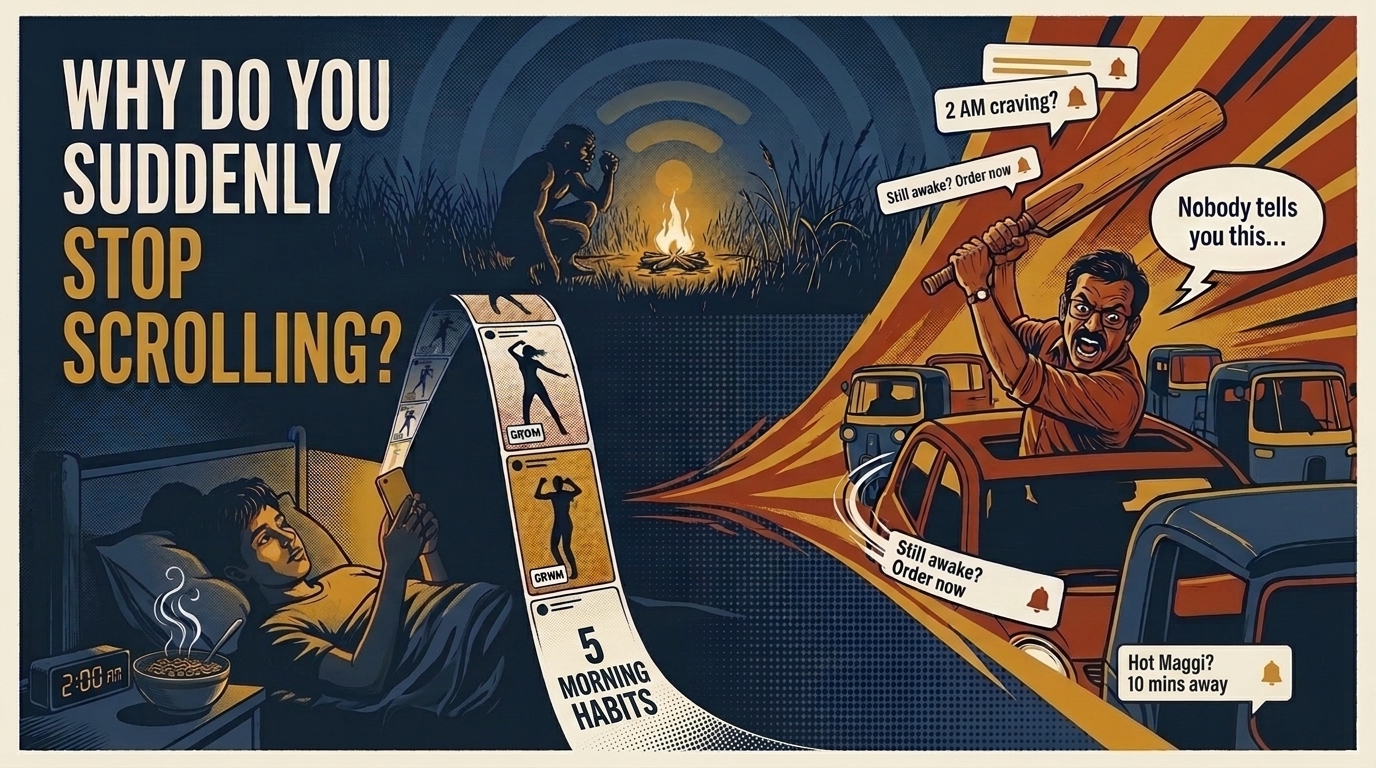
Have you ever noticed that you have opened Instagram for five minutes and somehow, it’s been over an hour? You’ve seen a stranger’s breakup story, a dog refusing to take a bath, someone explaining how they got rich overnight and how another person spends lakhs in a minute on things which are undoubtedly stupid. Then suddenly, one reel makes you stop scrolling.
Maybe someone says, “I’ve never told anyone this.” Maybe they pull a face so funny you can’t get over it. Or maybe they say something so specific that you feel a little exposed. Now you’re watching the whole thing and checking their profile like a little detective.
So why that video, and not the twenty before it? Have you ever thought of it?
The reason behind it is that while you scroll, your brain is constantly taking in faces, sounds, captions and movement. But when everything looks alike, it stops paying attention. Another GRWM, another dance trend, another “five habits that will change your life” video at 2 AM.
Then something different shows up. An opening you didn’t expect, a strangely specific line or a clip that starts right in the middle of the drama. Your brain wakes up. This is called a pattern interrupt, which means when something breaks the usual pattern, you notice it. Researchers have long studied how sudden changes grab our attention, and great creators and outstanding marketers use the same idea to stop the scroll.
It also has an old survival link. For early humans, noticing something unusual could be the difference between safety and danger. Today that same instinct has us watching a 90-second video about a stranger’s office drama. Like seriously, evolution really did all that just for that Wi-Fi?
Do you remember the CRED ad where Rahul Dravid loses his temper in traffic? We know him as the calm, composed “Wall,” so seeing him shout was both shocking and hilarious. It worked because nobody saw it coming and people shared it without being asked. Other Indian brands also used the same trick in their own way. Zomato and Swiggy write notifications that sound like a friend teasing you. Fevicol builds ridiculous situations around one simple promise. Amul has an opinion on whatever is trending that week. These campaigns last because people rarely remember what a brand said. They remember how it made them feel.
Another big reason would be curiosity. A video that begins with “Nobody tells you this about your first job” makes you want to know what comes next. When we get only part of a story, our mind wants to fill in the rest. That’s what keeps you watching, as long as the video actually delivers, unlike the ones that say “wait till the end” for 45 seconds.
For anyone who is working in digital content creation or marketing, the first few seconds matter most. But getting the view and keeping the viewer are two different jobs. Here’s what tends to work, whether you’re a big brand or a small business:
- Start in the middle of the story. Skip the long intro and begin with the interesting part.
- Be specific. “My 2 AM hostel Maggi routine” feels more real than “my daily life.”
- Say something true. People can tell when a hook is empty.
- Deliver what you promised. If the payoff is good, viewers will trust your next video.
- Make people feel something. Humour, surprise and comfort get remembered far more than facts.
A local bakery, a thrift store on Instagram or a student selling handmade bracelets can all grow with this approach. You don’t need a big budget to make someone pause, just a clear idea and an honest tone. Giving the audience a reason to stay, laugh, think or send that video to three friends? That’s the real skill.
“Marketing is no longer about the stuff that you make, but about the stories you tell.” — Seth Godin